
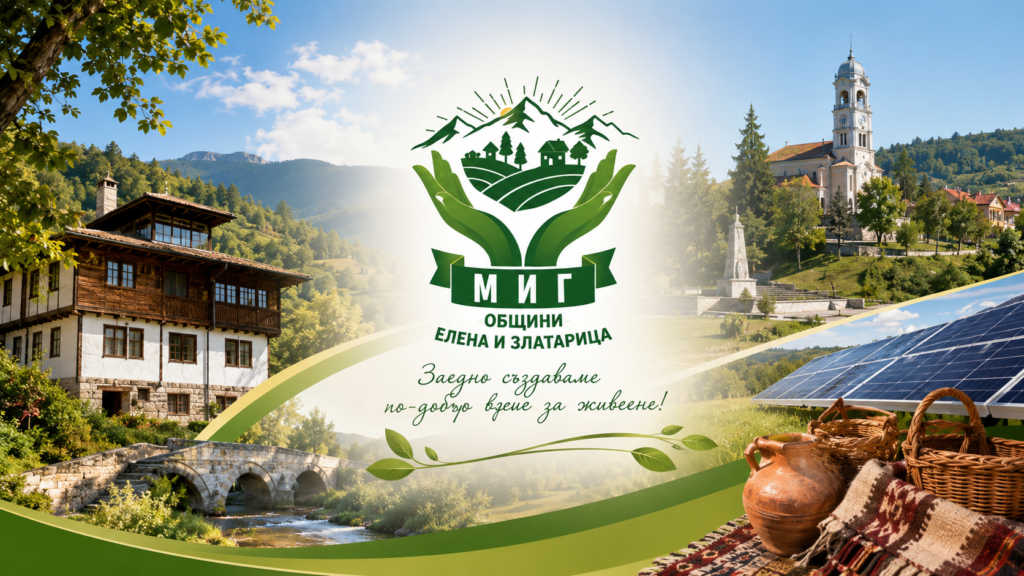
The Local Action Group “Elena and Zlataritsa Municipalities” has started the implementation of its Community-Led Local Development Strategy for the 2021–2027 period. The territory of the LAG covers the municipalities of Elena and Zlataritsa in Veliko Tarnovo region, with a total population of nearly 12,000 people. The main objective of the strategy is to support economic revitalisation and improve the living and business environment by building on local resources such as natural and cultural heritage, agriculture, tourism, education, community life and partnerships.
For organisations such as BRCK, these opportunities are important because several measures are directly connected to local communities, culture, education, youth participation, heritage preservation, ecology and the creation of a more active environment in small settlements. The strategy of the LAG places emphasis on social capital, the protection of cultural and natural heritage, capacity building and cooperation — topics that are closely linked to BRCK’s work in volunteering, local initiatives, media, culture and youth activities.
Cultural and Natural Heritage, Events and Smart Villages
One of the most relevant measures for non-governmental organisations, community centres and local initiatives is the measure “Studies and investments related to the maintenance, restoration and improvement of the cultural and natural heritage of villages, as well as smart village concepts.”
The aim of this measure is to support the preservation of the spiritual and cultural life of the population, local identity, traditions and natural heritage on the territory of the LAG. Eligible applicants include municipalities from the LAG territory, non-profit legal entities, community centres and local branches of religious institutions.
The measure can support activities such as local cultural events, folklore celebrations, village fairs, festivals, happenings, research and documentation of intangible cultural heritage, creation or enrichment of ethnographic, natural and historical collections, restoration of local customs, food traditions, crafts and rituals, as well as workshops and intergenerational clubs.
Support may also be provided for films, video clips, multimedia reconstructions, thematic studies, photo archives, catalogues, information materials, as well as the purchase of equipment such as musical instruments, traditional costumes, display cases, stage sets, interactive boards, multimedia equipment, laptops, lighting, sound, audio and video equipment. This is especially relevant for organisations that combine cultural events, local history, media content and work with young people.
From BRCK’s perspective, this measure could be connected to ideas for local festivals, cultural routes, documentation of local stories and traditions, media archives, video content, events in small settlements, intergenerational workshops, ecological actions and activities that bring together culture, nature and community.
The financial parameters of the measure are accessible for local initiatives: the minimum eligible project budget is BGN 4,889.50, while the maximum is up to BGN 50,000. The aid intensity is 100% of eligible costs, which means that an approved project can be fully funded within the eligible budget.
Opportunities in Education and Work with Vulnerable Groups
The LAG strategy also includes complementary funding under the Education Programme 2021–2027, through the procedure “Creating conditions for access to education by overcoming demographic, social and cultural barriers.” This procedure is aimed at addressing educational challenges in the territories of Local Action Groups.
Its main objective is to support the social inclusion of children and students from marginalised groups by improving their access to quality education. Specific objectives include reducing school dropout, improving the quality of preschool and school education, supporting the development of specialists in the education system, and strengthening the cooperation between schools, kindergartens, parents and local stakeholders.
Eligible applicants include municipalities, schools, kindergartens and non-profit legal entities with experience in education or working with vulnerable groups. Eligible activities include support for children and students, training for pedagogical and non-pedagogical staff for work in a multicultural environment, and activities involving parents and local communities.
This procedure is relevant for organisations working with young people, education, local communities and vulnerable groups. For BRCK, it may be particularly interesting in partnership with schools, municipalities, community centres or other local organisations, especially where activities are linked to non-formal education, parental involvement, student motivation, youth participation, media and creative formats, multicultural environments or local educational initiatives.
The procedure includes three application rounds: the first from 8 April to 8 July 2026, the second from 9 July to 9 November 2026, and the third from 10 November 2026 to 10 March 2027. Applications are submitted electronically through the ISUN 2020 system. The maximum duration of a project is up to 36 months, but not later than 31 December 2029.
Why This Matters for Local Communities
LAG “Elena and Zlataritsa” opens opportunities for projects that are not limited only to infrastructure or business development, but also focus on people, local memory, education, culture, nature and community life. This is especially important for small settlements, where a well-planned initiative can create new links between generations, activate young people, support local organisations and give visibility to cultural and natural resources that often remain undervalued.
For BRCK, these opportunities are close to the organisation’s previous experience — working with volunteers, cultural events, youth initiatives, media content, local communities, ecological actions and international partnerships. Potential project ideas could include local festivals, youth workshops, cultural, historical and natural routes, digital archives, video stories, educational activities, community events and partnerships with community centres, schools, municipalities and local action groups.
In Brief: What to Follow
For BRCK and partner organisations, several directions appear particularly relevant:
Culture and heritage — festivals, fairs, happenings, exhibitions, folklore, local traditions, crafts, culinary heritage, customs, photo and video archives.
Media and visibility — films, video clips, multimedia reconstructions, catalogues, thematic studies, information materials and documentation of local stories.
Nature and ecology — clean-up actions, protection of natural sites, rural landscape, paths, signs and small-scale infrastructure for recreation.
Education and inclusion — work with children, students, parents, schools, kindergartens, vulnerable groups and multicultural communities.
Smart villages — ideas for sustainable development, digitalisation, shared spaces, use of old buildings for community purposes and new models for living and working in rural areas.
These opportunities show that local development is not only an administrative programme, but also a tool for creating real initiatives that can remain in the community — as events, spaces, knowledge, equipment, partnerships and new forms of participation.
